The 3rd Plenum of the 14th Central Committee has officially concluded after four days of intensive deliberations. State media reported that in the first six months of 2026, Vietnam continued to achieve initial results in implementing the resolutions of the 14th Party Congress and reorganizing its administrative structure.
However, according to international observers, behind the “successful conclusion” painted by state media lies an ominous silence that clearly reflects the intractable nature of Vietnam’s economic challenges, for which no solution has yet been found.
Even in his closing remarks, General Secretary and President To Lam had to acknowledge that the biggest bottleneck currently lies in the implementation phase, where authority is not accompanied by accountability, decentralization remains lax, and macroeconomic forecasts have failed to keep pace with actual developments.
According to international observers, the silence surrounding the outcomes of the Third Plenum appears to be a necessary pause for the leadership in Ba Dinh to squarely confront an economic reality facing “fierce” headwinds from both within and without.
Meanwhile, while the official reports from Le Minh Hung’s government choose to downplay the situation by glossing over the numbers, the economic picture as seen by observers is revealing shades that are considered as dark as a pitch-black jar.
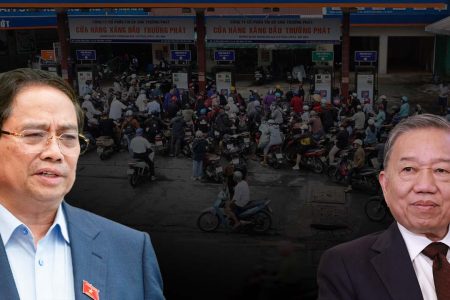
The people of Vietnam today seem to have lost interest in Mr. To Lam’s macroeconomic reform slogans, instead harboring immediate concerns about “making ends meet” amid surging gold prices, stock market volatility, and inflation—all of which pose an imminent risk of bankruptcy.
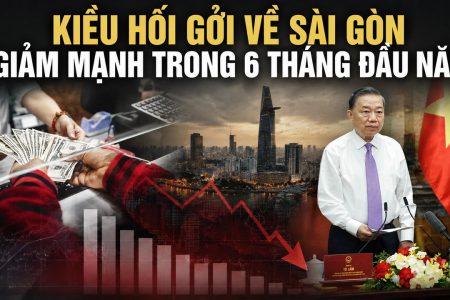
Notably, remittances—once a solid pillar supporting the domestic cash flow—have now recorded a sharp 23% decline in the first seven months of 2026, indicating that external financial support is gradually drying up.
At this very moment, another devastating blow has struck: as of July 24, the United States officially imposed an additional 12.5% tariff on all goods exported from Vietnam—putting the massive trade surplus with the U.S. market in a life-or-death situation.
More alarmingly, the structure of Vietnam’s trade is revealing a “frightening” imbalance: as of mid-July 2026, the trade deficit had surpassed the $20.46 billion mark, driven by a flood of Chinese goods—a record-high trade deficit not seen in over 30 years.
Furthermore, liquidity pressure within the banking system is reaching “red alert” levels, with State Bank of Vietnam Governor Pham Duc An acknowledging that up to 80% of mobilized capital is short-term, while businesses’ demand for medium- and long-term capital accounts for the majority—a situation that has driven borrowing costs to sky-high levels.
Most notably, the country’s foreign exchange reserve buffer now stands at only about 87.6 billion USD—a figure equivalent to less than two months’ worth of imports—which is believed to have pushed the ratio to the brink of a dangerous level.
As foreign currency cash flows have been choked off, the risk of liquidity crises spreading from large corporate chains across the entire market has become evident—from the installment payments on gold by major gold companies to the turmoil in the securities market.
Large conglomerates relying on public-private partnership models with high debt leverage are also facing unpredictable systemic risks; fortunately, the policy of mobilizing gold from the public has inadvertently become a short-term lifeline to balance cash flow, though it still cannot resolve internal resource constraints.
The recently concluded 3rd Plenum of the 14th Central Committee ended quietly for such reasons, and for now, Vietnam’s leadership remains preoccupied with reshuffling seats of power or renaming government agencies.
Yet they have overlooked an economic sector demanding painful and sweeping reforms—unless they wish to face a full-blown crisis.
Trà My – Thoibao.de